How D.C.’s cannabis beverages plan would let breweries and distilleries produce alcohol-free THC drinks for the city’s medical market
Washington, D.C., is not trying to turn every bar fridge into a THC cooler. At least not with this bill.
What Mayor Muriel Bowser rolled out Thursday is much narrower and, politically, much cleaner than the more breathless version of this story now bouncing around social feeds. Her administration’s Medical Cannabis Beverage Product Amendment Act of 2026, announced in a mayoral release, would allow certain D.C. breweries and distilleries to make alcohol-free medical cannabis beverages through partnerships with licensed cannabis manufacturers. The bill does not open the door to THC cocktails at neighborhood bars. It does not allow weed sodas in grocery coolers. It does not create a free-for-all adult-use beverage market.
Instead, it builds a tightly controlled production lane inside D.C.’s existing medical cannabis system.
That distinction matters because the policy is being sold on two tracks at once. The first is economic development. Bowser’s office says the city already has regulated alcohol manufacturers with bottling expertise and production equipment, while some cannabis operators do not have beverage-scale capacity. The second is patient access. District officials are pitching cannabis drinks as another smoke-free option for registered patients, including people who may prefer not to inhale at all.
Those are real arguments. They are also more limited than the headline version of “D.C. greenlights cannabis drinks” suggests.
Under the bill, holders of a manufacturer’s license Class A or B could apply for what the legislation calls a medical cannabis beverage production endorsement. With that endorsement, an alcohol manufacturer could receive cannabis or THC from a licensed medical cannabis manufacturer, produce a beverage under a written agreement, and then deliver the finished product back to that same cannabis manufacturer. The bill says the beverage cannot contain alcohol, and the endorsement holder cannot send the finished drinks to retailers, internet retailers, or the general public. It can only return them to the licensed cannabis manufacturer that supplied the THC or cannabis in the first place.
That is not a loophole. That is the point.
The fact sheet released by the mayor’s office makes the restrictions even plainer. Sales would be prohibited in bars, restaurants, liquor stores, and grocery stores. Products would only be available through licensed medical cannabis retailers, and only to registered patients. In other words, D.C. is trying to borrow the beverage know-how of breweries and distilleries without importing the alcohol industry’s public retail footprint into cannabis.
That approach makes a certain kind of sense. Beverage manufacturing is not just another edibles line with prettier packaging. It takes filling equipment, formulation knowledge, quality controls, shelf-stability work, and a production culture built around consistency at scale. D.C. officials are effectively saying the city already has businesses that know how to do that. Why make cannabis manufacturers reinvent a bottling plant from scratch if a regulated local producer can do the job under a written agreement and under cannabis rules?
That business logic showed up clearly in local framing around the proposal, including Axios’ reporting and the mayor’s own announcement. There is also a broader market backdrop here that reaches well beyond the District. In 2022, about 17.7 million Americans reported daily or near-daily marijuana use, compared with 14.7 million daily or near-daily drinkers, according to PBS. Reuters has also reported that U.S. bar spending softened as some consumers cut back, traded down, or experimented with alternatives including THC-infused beverages.
That does not mean cannabis drinks are destined to replace beer any more than hard seltzer was destined to replace water. It does mean lawmakers are legislating in a moment when the category has cultural momentum, especially among consumers who want something social, doseable, and not smoked.
For medical cannabis manufacturers in D.C., the appeal is obvious. The city’s current system already licenses manufacturers, retailers, internet retailers, couriers, and testing labs through the Alcoholic Beverage and Cannabis Administration. A manufacturer is allowed to process, package, and label products for sale to licensed retailers and internet retailers in the District, according to ABCA’s licensing guidance. What this bill would do is give those manufacturers a new way to get a beverage made by contracting with businesses that already know how to work in tanks, lines, and batches.
For breweries and distilleries, this is a possible side door into a growth category without pretending they are suddenly cannabis dispensaries. The bill’s annual endorsement fee would start at $500, which is low enough to invite interest. The harder question is whether the economics work once compliance, formulation, testing, packaging, transport, and limited distribution are all factored in.
That is where the excitement around cannabis drinks runs into the boring machinery that actually decides whether a product becomes real.
The proposal requires compliance with testing, electronic tracking, and reporting rules, and the mayor’s office says every beverage would need mandatory testing by a D.C.-licensed laboratory before retail distribution. Those safeguards are not ornamental. Cannabis beverages carry many of the same consumer-safety issues as other edibles, especially around onset time, dosing, and accidental overconsumption. The National Institute on Drug Abuse notes that when cannabis is consumed in foods or beverages, effects are typically delayed, often appearing after 30 minutes to an hour. That delay is one of the oldest traps in the edibles business: someone feels nothing, takes more, and then has a much longer evening than planned.
The National Academies’ 2024 report on cannabis policy and public health adds a bigger point. Product expansion is not just a business story. It is also a regulation story, a safety story, and a health-equity story. Good rules have to account for labeling clarity, child-resistant packaging, potency, education, and enforcement. That means the bill text is only half the story. The other half will be whatever ABCA eventually writes into rules around formulation, packaging, transport, and product handling.
There is also the market-size question, and this is where the proposal gets more modest than its buzz. D.C. does have a functioning medical cannabis channel. D.C. residents can register as patients, and non-D.C. residents can buy through temporary registration or reciprocity. Sales happen through licensed medical cannabis retailers, not through bars or corner stores. ABCA’s own medical cannabis metrics show a substantial existing market, with monthly activity in the millions of dollars by late 2025. That suggests there is at least a real base to sell into.
Still, a medical-only market is not the same thing as a mainstream beverage market. A product line can succeed inside a restricted channel, but that is very different from flooding regular retail with single-serve THC drinks and hoping consumers grab one next to a kombucha. Anyone calling this a local weed-beverage gold rush should probably hold the confetti until there is evidence of actual partnerships, actual products, and actual patient demand.
That narrower reality also keeps this story from neatly mapping onto Arizona or any other state. Arizona’s cannabis economy has its own rules, its own adult-use market, and its own consumer habits. The useful takeaway for operators outside D.C. is not that the District has found the one true model for cannabis drinks. It is that regulators are experimenting with a controlled hybrid: keep sales in the cannabis system, keep alcohol out of the product, and use local beverage infrastructure where it already exists. For cities trying to support small manufacturers without blowing up public-health guardrails, that is a notable template.
It is also a politically savvy one. Bowser’s pitch is not “let people get high at happy hour.” It is “let two regulated local industries collaborate under supervision to create a smoke-free product for registered patients.” That framing will not answer every criticism, but it gives supporters a cleaner argument in a city where lawmakers still have to think about safety, oversight, and federal weirdness every time cannabis policy moves an inch.
For now, the bill is just that: a bill. The D.C. Council still has to take it up, and the public record reviewed so far does not establish a final hearing or vote schedule. The bigger unknowns are practical rather than ideological. How many breweries or distilleries actually want the endorsement? How many cannabis manufacturers think the economics pencil out? What potency and labeling rules will regulators settle on? Can a patient-only channel support enough volume to keep anyone’s canning line humming?
Those questions are less glamorous than the headline. They are also the ones that matter.
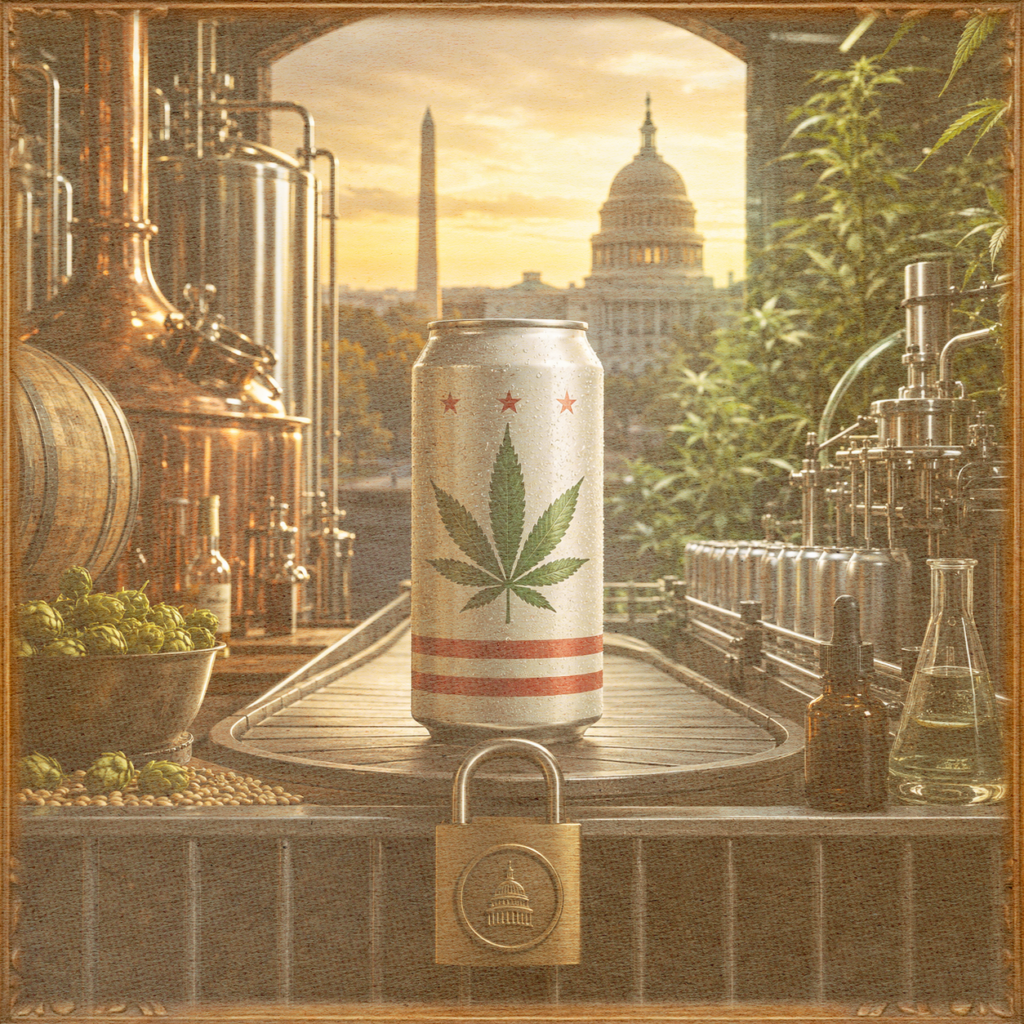
D.C. may indeed be on the verge of locally made cannabis drinks. That is true. It is just true in the most D.C. way possible: through endorsements, agreements, tracking requirements, and a carefully locked door between the brewery floor and the retail public. Call it a cautious step, not a cannonball.
***
Trap Culture is the ultimate destination for cannabis enthusiasts who want to experience the best of Arizona’s cannabis culture. Whether you are looking for the hottest cannabis-friendly events, the latest news on cannabis legalization, trends in the industry and exclusive, limited-edition products from the top brands in the market, Trap Culture has you covered. Visit our website to learn more about our events, our blog, and our store. Follow us on social media to stay updated on the latest news and promotions. Join the Trap Culture family and experience the most immersive and engaging social cannabis events in Arizona.
Follow us on social media