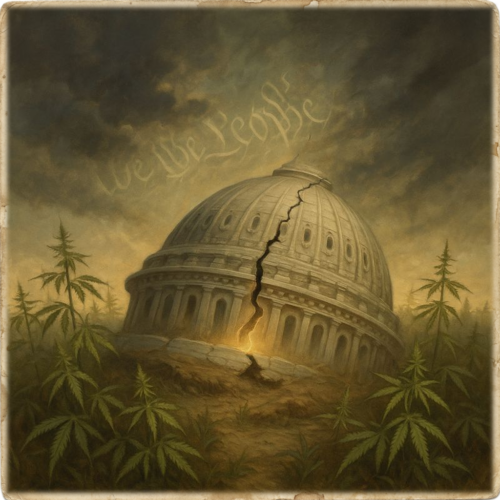
Conservative legal petition challenges federal authority to ban marijuana, urging the Court to revisit long-standing precedent on congressional power.
Core Legal Challenge: Supreme Court Petition
A conservative legal advocacy group has filed a certiorari petition asking the U.S. Supreme Court to strike down the federal marijuana ban. The group, identified as the Cato Institute in a report from Law360, claims that the Controlled Substances Act (CSA) oversteps Congress’ authority by criminalizing cannabis even when grown, distributed, and consumed entirely within the borders of a single state.
The petition urges the Court to revisit and potentially overturn its 2005 decision in Gonzales v. Raich, a landmark case that held Congress could prohibit even intrastate marijuana activity under its broad Commerce Clause powers. According to the filing, the CSA’s prohibition against marijuana violates the Tenth Amendment by infringing on states’ rights to regulate activities within their own jurisdictions.
Their argument: What happens in-state should stay in-state — especially when that state has legalized marijuana for recreational or medical use.
Legal Theory Advanced
At the heart of the petition is a renewed constitutional challenge to the scope of the Commerce Clause — the part of the Constitution that grants Congress the power to regulate interstate commerce. The petitioners argue that non-commercial, intrastate cannabis activity does not meet the legal definition of interstate commerce.
In their view, the CSA unlawfully criminalizes behavior that is entirely lawful under state law, raising serious questions about the balance of power between federal authority and state sovereignty. They contend that the 2005 Raich ruling — which was decided at a time when only a handful of states had medical marijuana programs — no longer reflects the current legal or cultural reality.
With 24 states and Washington D.C. having legalized recreational cannabis and over three dozen allowing some form of medical use, the petition argues that the federal justification for blanket prohibition has eroded.
Stakeholders / Incentives
The parties lining up on either side of this federal marijuana ban challenge represent a mix of legal, political, and commercial interests.
The petitioners — conservative legal strategists — are not traditional cannabis allies. Their motivation stems from a broader goal of limiting federal regulatory power. This challenge fits into a larger portfolio of efforts aimed at restoring what they see as constitutional limits on federal authority.
The cannabis industry, meanwhile, sees opportunity. For businesses navigating a patchwork of state-legal markets under constant threat of federal enforcement, a successful challenge could offer unprecedented clarity and stability. Bankers, investors, and entrepreneurs would finally be operating under legal protection rather than legal ambiguity.
The Department of Justice and Drug Enforcement Administration, on the other hand, are likely to resist any weakening of the CSA. The federal government has long maintained that uniform drug laws are essential to public safety and interstate coordination.
States with legal cannabis regimes are watching closely. They have a vested interest in protecting their regulatory autonomy and avoiding federal interference in state-sanctioned marketplaces.
Risks / Counterarguments
Despite the bold nature of the challenge, there are significant legal hurdles.
First, Raich remains good law. It upheld Congress’ ability to regulate even small-scale, non-commercial cannabis activity under the logic that it could affect the broader interstate market. That interpretation of the Commerce Clause has been consistently upheld in other contexts as well.
Second, the federal government can argue that weakening the CSA could open the floodgates to underregulated drug activity, undermining national drug policy goals.
Third, there’s the slippery slope argument: If the Court limits Congress’ Commerce Clause powers in this context, could that set precedent for challenges to other federal laws regulating intrastate activity — from firearms to labor standards?
Any move to weaken Raich would need to be carefully crafted to avoid broad regulatory rollback.
Data to Watch
Several indicators could signal how seriously the Court — and the broader legal community — takes this challenge.
The number of states with adult-use legalization continues to climb, bolstering the petition’s argument that the CSA is increasingly out of step with on-the-ground legal realities. As of November 2025, 24 states and Washington D.C. have legalized recreational marijuana.
Another key variable: amicus briefs. If state attorneys general or major industry coalitions file briefs in support of the petition, it could tip the scales by highlighting a widespread legal and economic interest in resolving the federal-state conflict.
Also worth tracking is how the Department of Justice approaches enforcement in the wake of the Trump-era rescission of the Cole Memo, which once guided prosecutors to deprioritize cannabis enforcement in legal states. A return to aggressive federal prosecution could make the Court more likely to take up the case.

***
Trap Culture is the ultimate destination for cannabis enthusiasts who want to experience the best of Arizona’s cannabis culture. Whether you are looking for the hottest cannabis-friendly events, the latest news on cannabis legalization, trends in the industry and exclusive, limited-edition products from the top brands in the market, Trap Culture has you covered. Visit our website to learn more about our events, our blog, and our store. Follow us on social media to stay updated on the latest news and promotions. Join the Trap Culture family and experience the most immersive and engaging social cannabis events in Arizona.
Síganos en las redes sociales